
© 1998 Steven L. Jacques, Scott A. Prahl
Oregon Graduate Institute
|
| ECE532 Biomedical Optics © 1998 Steven L. Jacques, Scott A. Prahl Oregon Graduate Institute |
Consider the scattering pattern from a 0.304-µm-dia. nonabsorbing polystyrene sphere in water irradiated by HeNe laser beam:
| np = 1.5721 | particle refractive index |
| nmed = 1.3316 | medium refractive index |
| a = 0.152 µm, | particle radius |
 = 0.6328 µm = 0.6328 µm | wavelength in vacuo |
As calculated before:
| nr = np/nmed = 1.5721/1.3316 = 1.1806 | relative refractive index |
| x = 2πa/(λ>/nmed) = (2)(3.1415)(0.152)/(0.6328/1.3316) = 2.0097 | size parameter |
Mie(nr, x) ---> S1(θ), S1(θ) as complex numbers
Mie(1.1806, 2.0097) ---> S1.re + jS1.im, S2.re + jS2.im as functions of θ
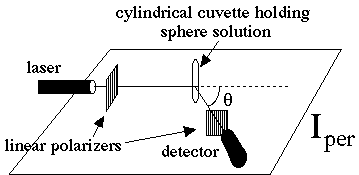
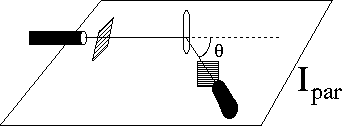
To view the results, calculate the intensities of scattering for parallel and perpendicular orientations of polarized source/detector pairs:
The following figures describe the experimental measurements that illustrate the angular dependence of the scattered intensities Ipar and Iper:
Polar plot
_polar.gif)
I(θ) plot
_xy.gif)
For a randomly polarized light source, the total scattered light intensity is given by the term S11:

S11 is the first element of the so-called Mueller Matrix, a 4x4 matrix which relates an input vector of Stokes parameters (Ii, Qi, Ui, Vi) describing a complex light source and the output vector (Is, Qs, Us, Vs) describing the nature of the transmitted light. For randomly polarized light, S11 describes the transport of total intensity: